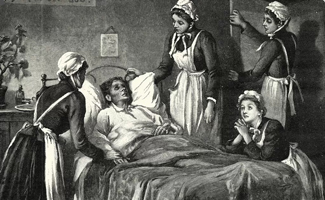
Medical Care for the Sick
♱ Introduction
Scripture accounts of Jesus’ ministry draw special attention to his acts of healing where he cleansed a man of leprosy, gave sight to the blind, enabled the mute to speak, cured a woman of hemorrhaging and even brought a young girl back to life.
“He took our infirmities, and bore our diseases.” (Mat 8:17)
When a loved one is sick or in the dying process, there are many critical medical decisions that must be made. We hope that the information contained here will serve to assist with those decisions.
♱ Nutrition & Hydration
Proper Nutrition and hydration is to be protected if the patient is not imminently dying. Nutrition can be delivered by whatever means, whether by mouth or by feeding tube. Hydration is also OBLIGATORY and does not constitute a special type of so-called “medical therapy.” Causing the death of the patient via STARVATION or DEPRIVATION is a moral evil.
There comes a time when food and water cannot be assimilated by a dying patient. As death approaches, the body begins to shut down, organ systems begin to fail, the digestive system no longer works properly, and food is not digested and absorbed. When the patient becomes unable to eat (digest) or drink (swallow) anything and death is very near, then feeding would not provide any benefit and may cause more discomfort. Careful consideration is necessary.
♱ Feeding Tubes
Some circumstances may arise to discontinue a feeding tube, such as a comatose patient who regurgitates the tube feedings and suffer aspiration. This would cause the patient more pain and suffering. Or a patient who has extreme agitation and may repeatedly try to pull out the feeding tube, reinsertion may become progressively more difficult and excessively burdensome.
♱ When the Patient is Reported to be “Unresponsive”
Some medical practitioners use the term “Vegetative State” as being synonymous with “Unresponsive” to physical stimuli. However, Being Unresponsive is not necessarily due to a patient being in a prolonged unconscious state, and it may be a temporary condition.
♱ Duty to Provide Care
Those few exceptions aside we have a duty to provide shelter and food to someone in need of it. A comatose patient should NOT be left to die, nor should he be starved to death. “The inherit value of human life at all stages, and in all degrees of capacity must be protected.”

Next, learn about Ordinary Vs. Extraordinary Care: