Why Have Masses Said For the Dead
♱ Introduction
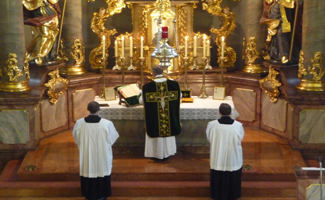
One of the most effective means we have to help the deceased is to have Masses celebrated for the souls of our relatives, friends and benefactors who may be suffering in that place of atonement called Purgatory. This is the most powerful prayer for them, followed by the Holy Rosary.
More souls are released by the Mass than any other means. St. Jerome was quoted to say, “For every Mass devoutly celebrated, many souls leave Purgatory and fly to Heaven!” Also, St. John Vianney (the Curé d’Ars) emphasized that the Mass is greater than any works performed and the most effective means to assist the Poor Souls in Purgatory, “All good works taken together cannot equal the value of a single Holy Mass!”
We can help the holy souls by offering a Mass for them. This involves speaking to a priest and arranging a date for the Mass.
♱ Gregorian Masses
Gregorian Masses come from an ancient tradition in the Church. It consists in having Masses celebrated on 30 consecutive days without interruption. The origin of Gregorian Masses comes from an event at the monastery of Saint Andrew in Rome and Pope Saint Gregory the Great. The saint himself narrates this episode in his Fourth Book of Dialogues:
“One monk named Justus had gathered three gold coins and kept them carefully hidden but thankfully he revealed this fault on his deathbed. To punish him in an exemplary way, I Pope Gregory forbade the community to visit him and pray around him as was ordinarily done. I also ordered Justus to be buried under a dung heap with the three pieces of gold. However, since he had repented, I did not want to deprive him of the Church’s prayers and ordered the Holy Sacrifice of the Mass to be offered for him for thirty consecutive days. After the thirtieth Mass, Justus appeared to a brother in the monastery, declaring that he had just entered Heaven due to the Masses offered!”
Following the example, Catholics throughout the ages kept the pious custom of having 30 Masses celebrated for deceased relatives and friends and later came to be called, “Gregorian Masses.” In ancient times of much faith, people commonly left some money to have Masses said for their souls over a long period. In recent times, some people have made a practice of setting aside money to pay for their own Gregorian Masses and even include that request in their Will or Trust.
As Gregorian Masses cannot be said for the living, the faithful should arrange to have them said for deceased family/friends as soon as possible after death.
Secular priests loaded with parish responsibilities generally find it difficult to fulfill all the conditions for accepting Gregorian Masses. Thus, it is usually easier to order them from convents, monasteries or residences of retired priests who have relatively fewer pastoral obligations and can celebrate the required 30 Masses.
The above text is taken from “What are Gregorian Masses and How Do They Help the Souls in Purgatory?” by Plinio Maria Solimeo, Tradition, Family and Property (TFP).
Next, see the Prayers for Dying Non-Catholics: